Showing posts with label stretching. Show all posts

Thursday, August 25, 2011

Nighttime Nuisance

        Recently, I saw a stunningly gorgeous lady, in sexy lingerie.  She was at the stairs of our house, signaling me to go up.  Curiously, I followed her, up to our 3rd floor. Then, this Angel Locsin look-alike continued going up to our 4th floor. There was a problem, though.  Our house didn’t have a 4th floor. But I followed her anyway. When I got there, boy, I was mesmerized with what I saw. Sexy, beautiful ladies I don’t know walking around, talking in some language I thought spoken only in the second Moon of planet Mars. Then, this beautiful lady I saw earlier moved towards me, about to hug me when…………………………...... I woke up!  Arrrggg! I woke up!   

       Darn. It dawned on me that I was only dreaming.   I was awakened because my wife woke me up because she felt severe muscle cramps in her leg.

       “Aww. Come on, Mama. Your leg cramp is such a kill joy. What I was witnessing was better than any erotic movie, I thought”.  Hehe. Well, after I massaged and stretched her affected leg, the cramps went away and she went back to deep slumber as if nothing happened. Unfortunately, I never got to finish the dream I was having =(. 

       Have you ever experienced the same thing?  No, not the same dream, but being awakened by severe leg cramps?

So, that brings us to the orthopedic topic of this post. Leg cramps.  

What is leg cramps?


      A leg cramp means a sudden, severe pain usually at the back muscle of the leg we call calf muscles. It is caused by a sudden involuntary contraction of these muscles.   

        It may occur when you are sleeping just like what happened to my wife. If not given the necessary attention, it can become a distressing problem which can disturb our regular sleep. 

What causes nighttime leg cramps?

      During cramps, your muscle contracts and doesn’t relax.  It may occur more often on people who don’t stretch enough or improperly stretch.  The following are risk factors for leg cramps:

1.      Prolonged flexion of foot - The nighttime leg cramps can be caused by prolonged and unopposed foot flexion while in bed. In the regular sleep position, the muscles of the feet and back of the legs are shortened because the foot is pointing slightly away from you. In addition, if you point your foot like a ballerina when you stretch, contraction of an already shortened leg muscle may occur and further cause the muscle to go into spasm.

2.      Electrolye imbalance - You can have nighttime leg cramps with heavy sweating from prolonged exertion. Muscle cramps happen more frequently during hot weather because we lose fluids when we’re hot and sweaty. We also lose electrolytes—especially potassium and magnesium.  These nutrients are needed to prevent muscle spasms.

3.      Certain Medications – Consumption of diuretic drugs, calcium channel blockers, can also cause nocturnal leg cramps. 

4.    Certain medical conditions – This includes later stages of pregnancy, untreated hypothyroidism, hypoglycemia, those undergoing hemodialysis, and excess alcohol intake.

However, these are just the probable causes, and a definite cause of leg cramps while sleeping at night still has to be verified.

What to do

        I wish I could tell people that all you had to do is this and that and miraculously your cramps will be a thing of the past. Problem is, no one even knows for sure what causes cramps.  But here are some accepted ways to prevent leg cramps.

1. Stretching exercises- 

      Making  regular stretching  a habit is a good start for preventing leg cramps.  Focus on exercising the calf muscle while doing the stretching exercises. Stretch your calf muscles by pointing your foot towards you. You may try to do some routine stretching before bedtime. Try this out for a week or so, you would most probably see the difference.


2. Appropriate sleeping posture-

      Well, of course, if you’re sleeping you won’t be aware of your posture. But a change in your sleep posture can prevent leg cramps. Try keeping a pillow under your calf before you sleep, if you are lying on your back. Letting the feet hangover the edge of the bed is another way to relax that muscle and avoid leg cramps at night while sleeping.

3. Get properly hydrated - 

         As mentioned, loss of fluids and essential nutrients could be a cause of cramps. So make sure you drink lots of water and juices.  Avoid dehydration!

Daily activities that might help prevent night leg cramps include:
  • Maintain  correct posture of your feet. Remember my discussion about high heels?  If not, browse through the previous posts and learn again.
  • If you have no plans of being a ballerina, avoid the temptation of pointing your toe! (Unless you use your toes to signal directions to people). 


4. Gently and carefully massage your calf muscles every now and then

    5. Take a warm water bath before going to bed – 

              I know that for some of you, you don’t like taking a bath. It’s like water torture.  And for some hardline environmentalists, they want to conserve water so bathing is absolutely unnecessary for them.     Kidding aside, taking a warm water bath may relax your cramped and tired muscles. If you’re too lazy or sleepy to take a bath at night, then you may just use a warm pack and apply it around your affected muscles.
      Summary

             Leg cramps can really be a painful nuisance, especially for nighttime leg cramps. Theories of its cause include improper position of feet, dehydration, electrolyte imbalance, certain medical conditions and medicines. Make sure you do calf stretching exercises, maintain proper position of your feet, and be properly hydrated. Gently massaging your calf muscles and applying warm compress may help in relaxing the cramped muscle. 

              If you have a muscle cramp that lasts for more than a couple of days, see your orthopedic surgeon. You may have a muscle tear, blood clots, nerve damage, or some other more serious problem that will prevent you from having and finishing the same dream that I had. =)

      Sunday, June 5, 2011

      5 Deadly Orthopedic Mistakes While Surfing Facebook


      Facebook has revolutionized the way people communicate throughout the world.  There are currently more than 500 million active users of Facebook throughout the world and roughly half of them log on in any given day.  The Philippines ranks first among Facebook penetrated countries. (http://www.blazin100.com).  This means that we, Filipinos, are spending a lot of time sitting in front of our computers accessing our FB.  So what does frequent facebooking have to do with orthopedics? 

      The following are orthopedic mistakes while using Facebook, and computers in general, that have been uncovered in ancient China by a Panda that uses Kung Fu.  It became available to a Tigress, Crane, Mantis, Viper and Monkey.  Ok. Ok.   I’m just pulling your leg.  Seriously, the following orthopedic mistakes are associated with frequent use of computers in general:

      1.       Sitting in front of the computer for long periods of time
       This may cause general body aches especially low back pain.  I read this somewhere: “Give a man a fish and you feed him for a day.  Teach a man to use Facebook and he won't bother you for weeks”.  But an hour or more spent in front of the computer is simply punishing your back.  One tends to maintain a single position, with the mind focused on the computer task. The muscles in the upper back, which connect the shoulders and help to keep our back straight, become tense, stiff and painful.   Back pain has always been a common complaint of people whose work involves sitting in front of the computer such as call center agents and secretaries.

      The Solution:  Avoid prolonged sitting by taking frequent breaks.  You can also stretch our regularly at your desk or vary positions every so often to stretch your back and relax your muscles. Set a timer to remind you to take a break or change positions every 30 minutes, or purchase software with a window that pops up with simple stretches you can do at your desk.  You can also put little notes around your computer screen to remind you to stretch!  Eventually, stretching frequently will become a habit and prevent lower back pain.
       
      2.       Improper posture
      Improper posture like slouching for extended periods may make you prone to develop general aches and pains in the neck, shoulders, arms, back, thighs, and lower legs. The muscles on the front of your torso shorten and your back muscles become weak and stretched out. Over time, you may develop slumped posture, rounded shoulders and a forward neck posture, leading to chronic back and neck pain.

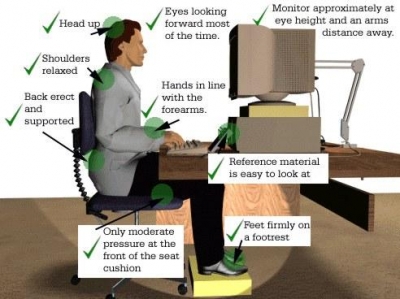
      The Solution: A good sitting position while using your computer is vital. Your feet should be flat on the floor (or on a footstool) and your back straight to maintain the normal curvature of your spine.  The computer monitor should be at eye level.  If the seat is adjustable, adjust it to your height can encourage better posture.  If the seat isn't adjustable and the lower back is not supported, roll up a towel or use a small cushion for support.  Pull the chair close to the desk to avoid leaning forward that puts strain on your back.  Position your thighs horizontally with your knees at about the same level as your hips.    

      3.       Prolonged repetitive typing on the computer keyboard

      Typing on the keyboard at the wrong height/ angle, or using wrong-sized mouse or keypad, or generalized fatigue are a few of the possible conditions that can cause repetitive strain injuries (RSI).  Carpal tunnel syndrome and tendinitis may eventually develop over time.


      The Solution: Perform hand and wrist exercises to stretch and strengthen the muscles.  Wrist pads are readily available and help by maintaining normal hand position.  Most importantly, rest your fingers and hand frequently to avoid fatigue.

      4.       Keeping frequently-used equipment and gadgets out of reach

      Any equipment you use frequently throughout the day such as document files, the telephone and writing materials, should be easy to reach without overstretching.  Constant use of the telephone - particularly if it's cradled between the ear and shoulder - can result in tension to the neck and shoulder area.

      The Solution: Use a properly set-up workstation. Keep your gadgets and work materials within your reach to avoid overstretching. 

      5.       Cramped up work space.
      You are less productive and efficient at a workstation that does not fit your body size. 

      The Solution:  Quite simply, the bigger you are, the more working space you need.  It is suggested that the ideal workstation lets you work in natural (neutral) postures that minimizes strain on your body.  A workstation mismatched with your body may force you into uncomfortable postures such as hunching over, slouching, straining, or twisting.

      The bottomline:  Listen to your body.  If something hurts, your body is trying to send you a message.  Give yourself a break.  I’m sure you’ll agree that spending fewer hours at your computer is worth preserving the health of your body in the long run.  Rest is probably the biggest treatment for these problems.  If you start having any kind of discomfort from using the computer, take a break or stretch out.  Don’t try to push through the pain no matter how many Friends are waiting for you to comment.
       ____________________________________________

      Orthopedic Joke:

      Hot Water or Cold Water

      A business executive injured his leg skiing one weekend. By the time he got home Saturday, the leg was very swollen and he was having difficulty walking, so he called his physician at his home. The doctor told him to soak it in hot water. He tried soaking it in hot water but the leg became more swollen and painful. His maid saw him limping and said, "I don't know, I'm only a maid, but I always thought it was better to use cold water, not hot, for swelling." He tried switching to cold water and the swelling rapidly subsided. On Sunday afternoon he called his doctor again to complain. "Say, what kind of a doctor are you anyway? You told me to soak my leg in hot water and it got worse. My maid told me to use cold water and it got better." "Really?" answered the doctor, "I don't understand it. My maid said to use hot water."  

      Blog Archive